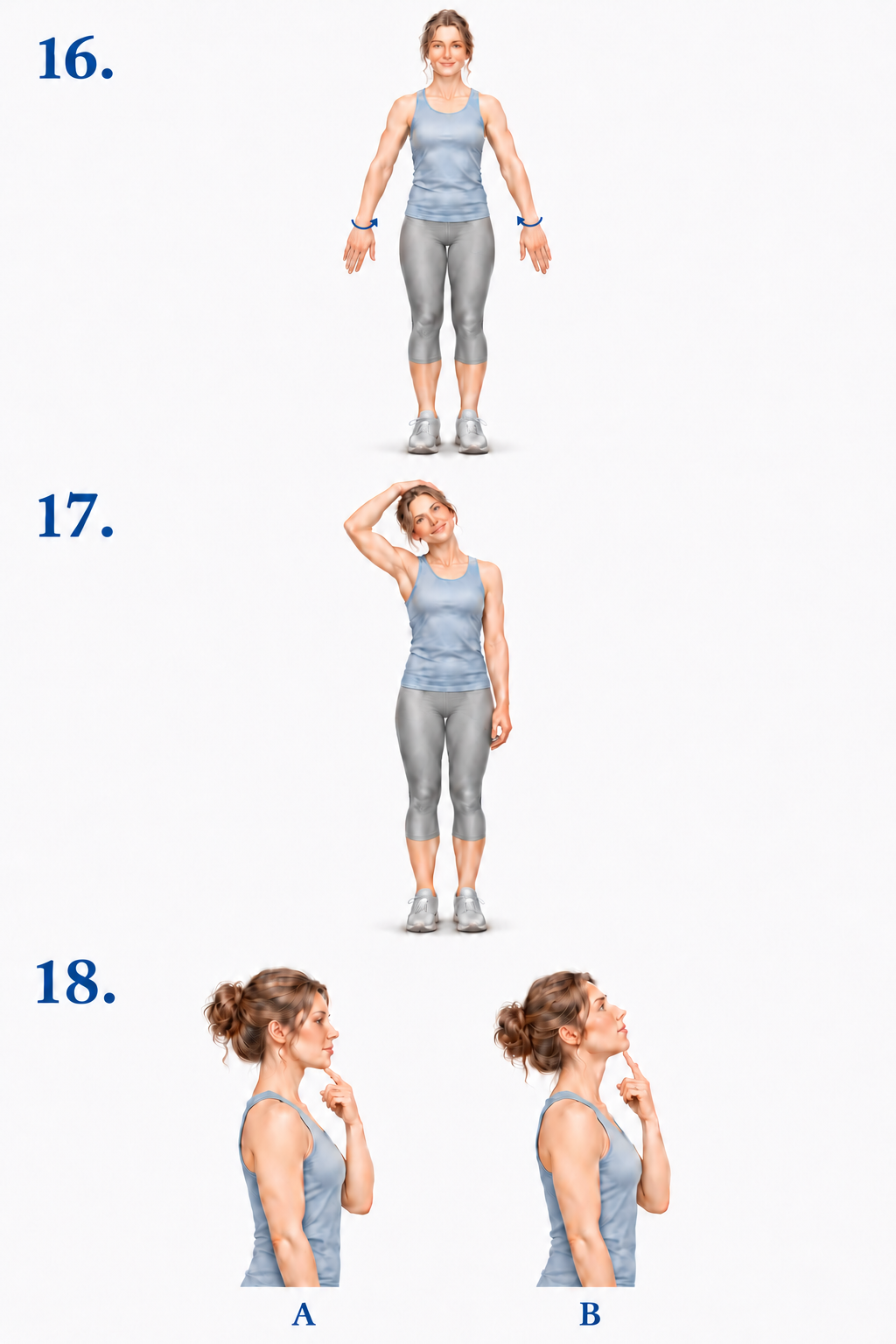
Let your arms rest beside your body with your elbows comfortably straight.
Turn your hands inwards, allowing your forearms to turn with them. Keep your upper arms relaxed and your elbows comfortably straight.
Keep the movement small and your shoulders relaxed. Return slowly.
Keep in mind: The arrows wrap halfway around the wrists: right thumb counterclockwise and left thumb clockwise in the illustrated view. Avoid locking your elbows or forcing your wrists.
STRETCH 17 / Side of the neck
Gentle neck side stretch
You’ll need: A steady, comfortable position.
Look forwards and relax your shoulders.
Tilt your head gently towards one shoulder while keeping the opposite shoulder down.
If comfortable, rest your hand lightly on your head without pulling. Return to the middle and change sides.
Keep in mind: Your hand is a light resting contact, not a lever. Stop if you feel pain, dizziness, tingling or numbness.
STRETCH 18 / Front of the neck
Chin tuck and gentle neck extension
You’ll need: A steady position with your shoulders relaxed.
A: Gently draw your chin back, keeping your gaze level.
B: Keep that small chin tuck as you tip your head back only a little, within a comfortable range.
Return to the level position slowly. Keep breathing and avoid forcing the movement.
Keep in mind: This movement is not suitable for every neck problem. If you have neck symptoms, obtain individual guidance before trying it; stop for pain, dizziness, tingling or numbness.
AT YOUR OWN PACE
Make room for everyday care.
Choose the movements that suit you. Pause, adapt or seek guidance when needed.
This routine includes 18 stretches with a 10-second starting hold. Instructions have been edited for clarity and comfortable-range guidance, and the illustrations redrawn in the Dr Posture exercise style. This is an author-review edition.
General stretching guidance and sources
Hold times and suitable movements vary with the person and the purpose. The 10-second hold here belongs to this routine; it is not a universal prescription. These general guidance sources support gentle, controlled stretching and individual adaptation, rather than validating this complete sequence.