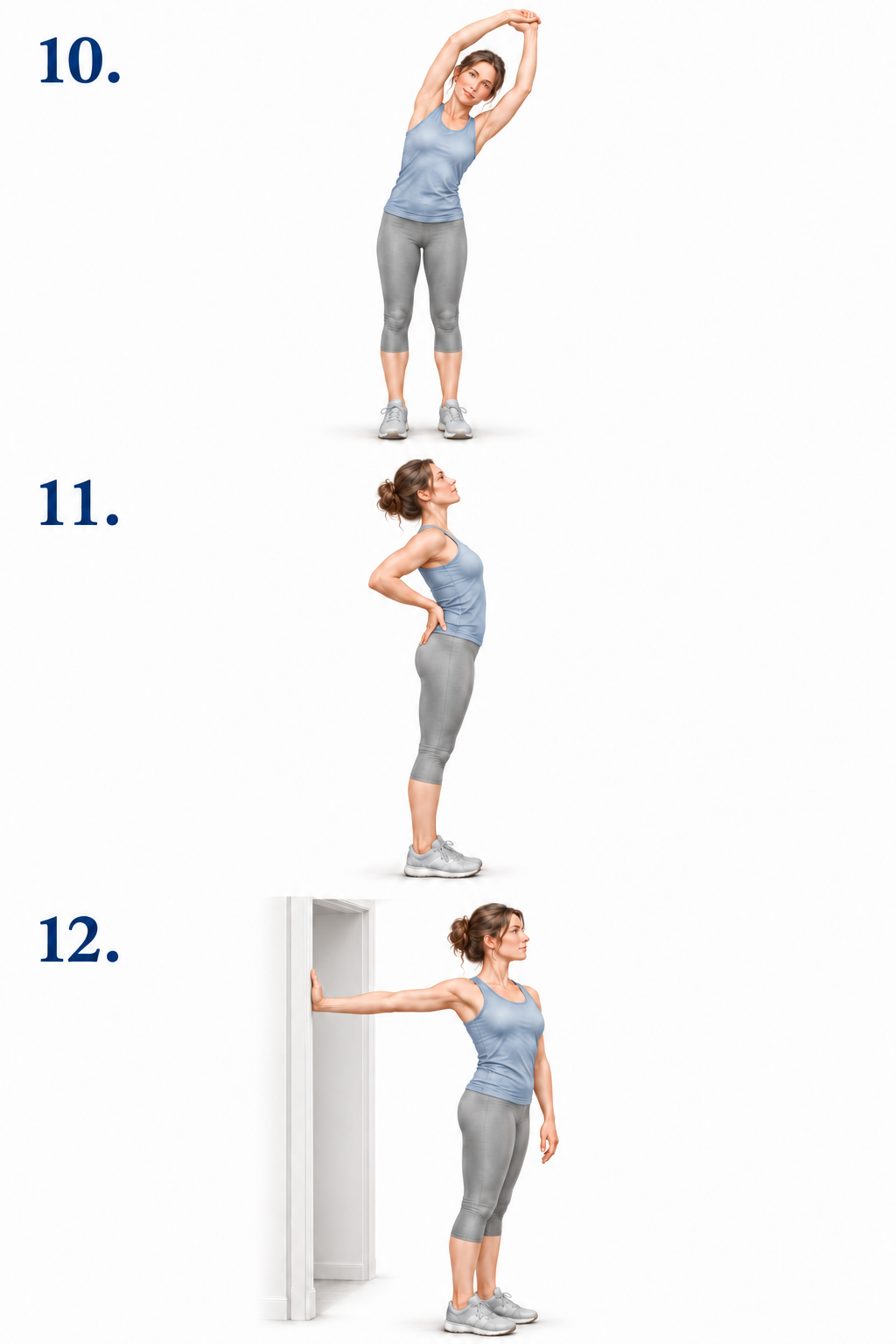
Stand with your feet comfortably apart and raise your arms overhead.
Hold one wrist with the opposite hand.
Reach gently towards the side of the holding hand, allowing a small side bend. Return upright and change sides.
Keep in mind: Keep both feet on the floor. Guide the wrist gently rather than pulling hard.
STRETCH 11 / Front of the trunk and hips
Gentle standing extension
You’ll need: A clear, stable standing area.
Stand with your feet comfortably apart and place your hands on your lower back.
Keep your knees soft and use your hands for support.
Lift your chest and lean back a small, comfortable amount. Return upright slowly.
Keep in mind: Avoid a deep backbend or throwing your head backwards. Stop if this brings on back or leg symptoms.
STRETCH 12 / Chest and front of the shoulder
Supported chest stretch
You’ll need: A secure doorway with an accessible inner doorframe.
Place your hand upright against the inside face of the doorframe at about shoulder height. Your fingers extend into the doorway, with your thumb visible on the edge.
Keep that hand in place and slowly turn your feet and body away from the arm.
Allow your head to follow your body comfortably. Stop at a gentle stretch across the chest, then return and change sides.
Keep in mind: Keep your wrist naturally aligned with your forearm and your shoulder comfortable. Do not force the arm behind you.
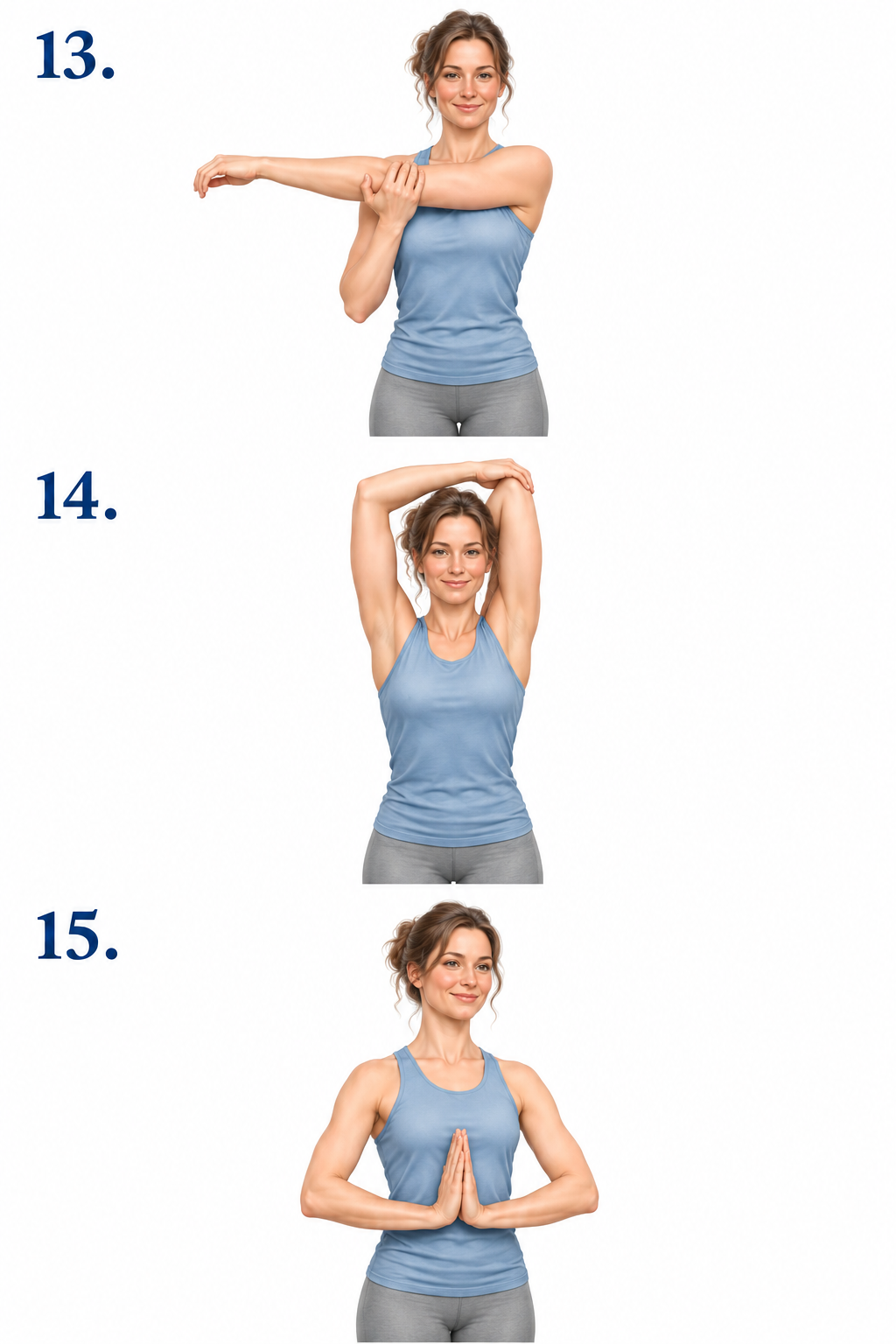
STRETCHES 13–15
Shoulder, upper arm & forearms
Match each illustration number with its instructions. Start with a gentle 10-second hold; change sides where applicable, then repeat once.
This routine includes 18 stretches with a 10-second starting hold. Instructions have been edited for clarity and comfortable-range guidance, and the illustrations redrawn in the Dr Posture exercise style. This is an author-review edition.
General stretching guidance and sources
Hold times and suitable movements vary with the person and the purpose. The 10-second hold here belongs to this routine; it is not a universal prescription. These general guidance sources support gentle, controlled stretching and individual adaptation, rather than validating this complete sequence.