
EVERYDAY POSTURE / sitting
Sitting, with support.
Arrange the seat and task so you can settle comfortably and move freely.
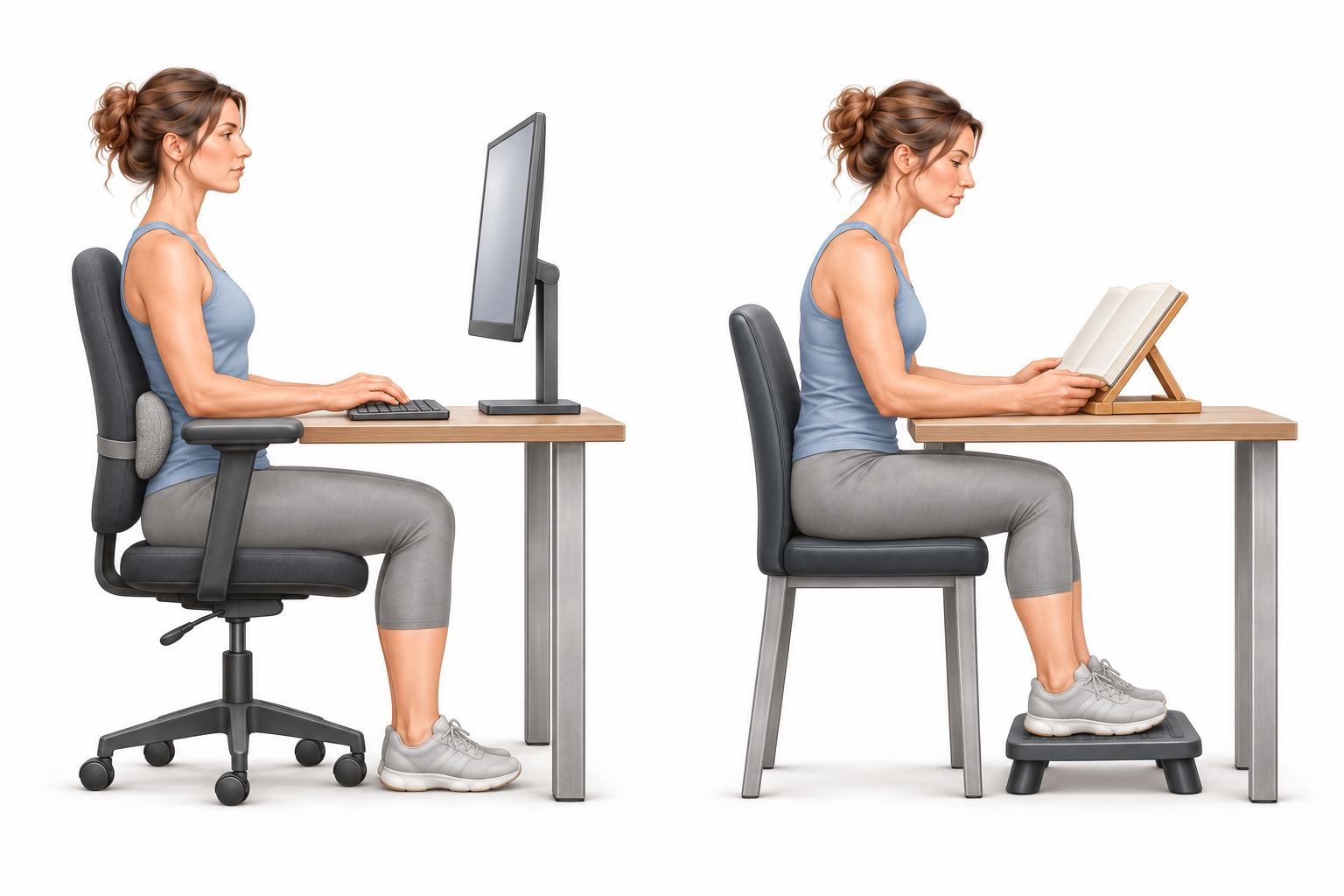
Let the chair share the work.
- Sit back into the support. Bring your buttocks towards the back of the seat. Adjust the backrest to meet your lower-back curve; a small lumbar roll or rolled towel can help if it feels comfortable.
- Support both feet. Use the floor or a stable footrest. Leave a little space behind your knees so the seat does not press into them.
- Relax your shoulders and arms. Bring the chair close enough that your forearms can rest comfortably on the desk and the keyboard and mouse are easy to reach.
Bring the task towards you.
- Make the screen easy to see. Adjust its height, distance and text size so you can read without repeatedly craning forwards. For longer laptop use, a separate keyboard and mouse let you raise the screen independently.
- Support reading and writing. Bring the work closer. A bookstand or suitable forearm support may help you avoid a prolonged unsupported reach.
- Keep changing. Shift, stand or walk when the task allows. WorkSafe Queensland suggests changing position about every 30 minutes; this is a useful reminder, not an exact injury threshold.
WorkSafe Queensland · Setting up your workstation ↗ · WorkSafe Queensland · Staying active at your computer ↗
Do I need a seat wedge?
A chair wedge is an optional support for forward sitting. Try it only if it helps you settle comfortably. It should feel stable, keep your feet supported and avoid making you slide or strain. An adjustable chair may already provide the support you need.
A gentle forward lean for a task is a normal movement. The useful question is whether the reach, support and time in that position suit you.
Use the full desk checklist ↗ONE PART OF EVERYDAY CARE
Support. Movement. Capacity.
Useful support changes the demand. Regular movement varies it. Appropriate exercise helps build what your body can do.
Explore the exercise library ↗Explore Stretching for Life ↗Adapted from Dr David Shahar’s original posture teaching, with updated guidance and newly created illustrations. Sources checked on 3 November 2026. © 2026 Dr Posture Pty Ltd and Dr David Shahar, DC, PhD.