
EVERYDAY POSTURE / thoracic pillow
A thoracic pillow:
support with a purpose.
Understand what the support is intended to do—and whether it suits you.
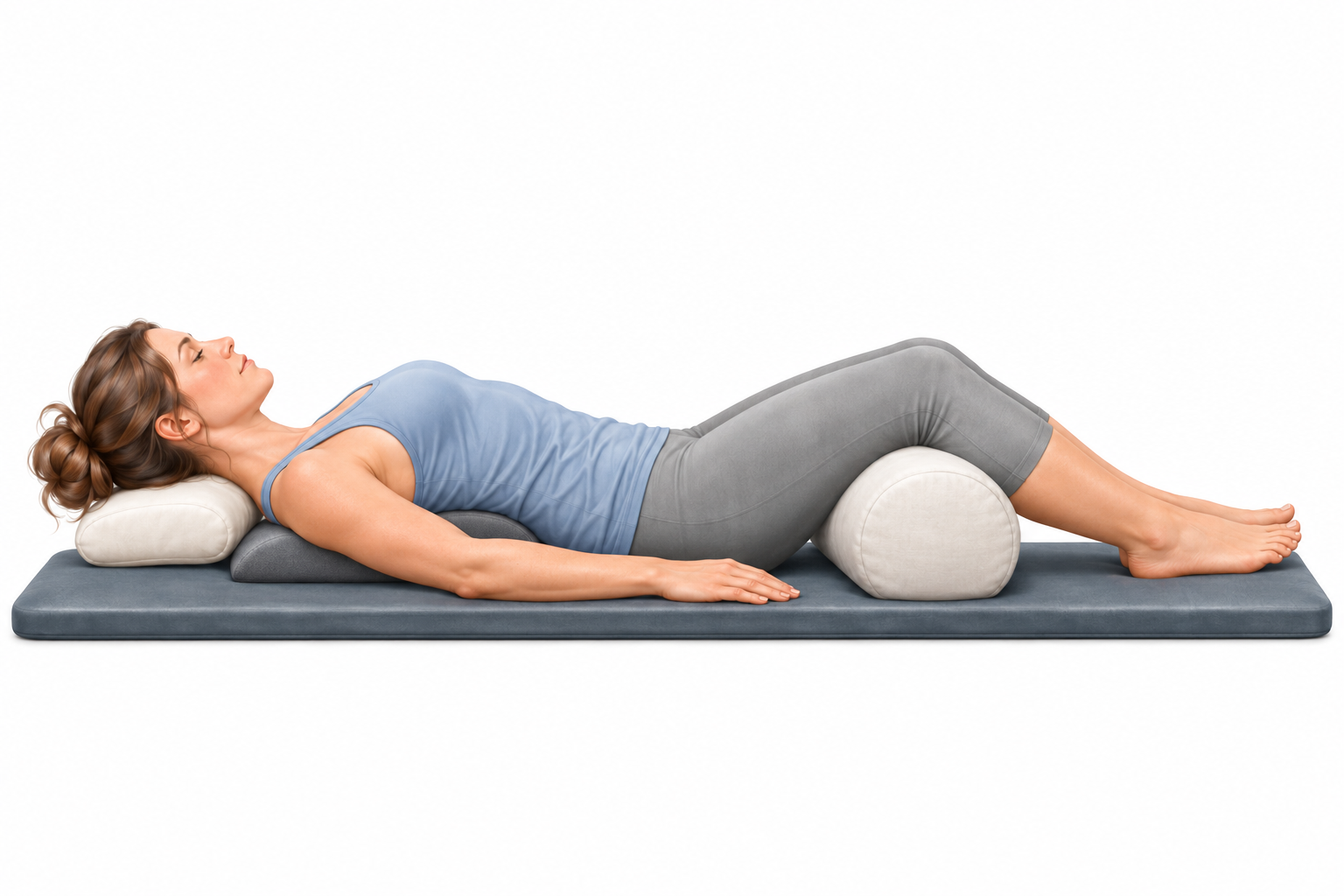
What is a thoracic pillow?
“Thoracic” means the part of the spine behind the rib cage. A thoracic pillow is a shaped support beneath this area, used while lying on your back, often with a bolster beneath the knees.
Its intended purpose is gentle upper-back support and extension—a small movement towards opening the chest. It is different from an ordinary sleeping pillow or a lower-back roll.
Use an individually fitted setup.
- Check suitability first. Ask a clinician before trying this if you have osteoporosis, a spinal fracture, a recent injury or operation, or unexplained spinal pain or nerve symptoms.
- Use the correct support and position. Follow your clinician’s and the product’s instructions for height and placement under the upper back. Support the head and neck as needed; do not let the head hang backwards.
- Keep the rest comfortable. A knee bolster may help you relax. Breathe normally and avoid forcing a stretch or an arch through the lower back.
- Let your response guide you. Use only the duration agreed for you. Stop if you develop pain, dizziness, tingling, numbness or breathing difficulty.
How long should I use it?
There is no single duration that suits everyone. The appropriate time depends on your condition, the support and how you respond. Follow your individual plan rather than assuming that a 10-minute session is right for you.
This page describes a supervised setup concept. Do not use a thoracic extension support as an overnight sleeping pillow unless your clinician has specifically advised it.
What can we reasonably expect?
Thoracic extension exercises appear in physiotherapy guidance. That supports their use in selected care plans, but does not establish the effects of this particular pillow or a 10-minute routine.
A support may make a position or movement more comfortable. Claims that it reverses spinal degeneration, permanently corrects all postural faults or prevents nerve damage are not established by those sources.
Cambridge University Hospitals · Thoracic spine exercises ↗ · NHS · Osteoporosis ↗
Looking for everyday sleeping support? ↗ONE PART OF EVERYDAY CARE
Support. Movement. Capacity.
Useful support changes the demand. Regular movement varies it. Appropriate exercise helps build what your body can do.
Explore the exercise library ↗Explore Stretching for Life ↗Adapted from Dr David Shahar’s original posture teaching, with updated guidance and newly created illustrations. Sources checked on 3 November 2026. © 2026 Dr Posture Pty Ltd and Dr David Shahar, DC, PhD.